Wednesday, May 9, 2018

Black MonoKimono - Non-Mofuku

I finally was able to do my long-time dream ensemble! An all black non-mofuku kitsuke!

I have struggled for years with how to make this kitsuke a reality. I debated whether or not to alter mofuku items to fit the theme or to hunt out specifically black but non-mofuku items. I decided on the latter. Truly, the kimono itself was the most challenging part. Most black kimono are kuromontsuki and are far too formal what I had in mind. Other mostly black items have very bright patterns that detract from the aesthetic I was aiming for. This komon that I used for the ensemble was one that I had custom made (due to my "larger than average Japanese size"... that would be a US L typically...). It took several months for it to be tailored, so while it is awase, and it is now long past awase season where I live, I figured I could give it a go in my well air-conditioned apartment. 

This was the final result:


Admittedly, some of the pieces are a little less black than the others, and I wore white tabi because I’m not a fan of black or patterned tabi usually. The hardest thing to see may be the obijime as it actually has small red threads throughout. 


The obi might be mistaken as having metallic threads, but it is actually cleverly woven to trick the eye into thinking that. It is actually just black and grey. It is one of two authentic Nishijin-ori nagoya obi in my collection that I had made-to-order, and it is one of my favorites.

The only plain black item is the haneri, but as white haneri are typically worn with mofuku, this should not be mistaken for funeral wear. 

I’m really happy with the ensemble, and I can’t wait to wear it again!

Saturday, March 17, 2018

March Fudangi Friday with Sakura

๐ŸŒธ๐ŸŒธ๐ŸŒธ Belated Fudangi Friday with blooming sakura ๐ŸŒธ๐ŸŒธ๐ŸŒธ

This is a cotton kimono with a lace overlay share fukuro obi, mint green obiage, and brown obijime. The sakura are blooming here so I wanted to do an ode to them (pink, green, and brown for petals, leaves, and branches) without outshining them.

Saturday, March 3, 2018

Hakama as Skirt

Not full kimono, but I wore pink hakama as a skirt for a concert tonight. 


Sunday, January 28, 2018

Fudangi Friday - January Edition

Ever since the first one, I keep missing Fudangi Friday! ๐Ÿ˜… So here’s the belated Sunday addition! 


I wore a light purple yuki komon, yuki obiage, brown wool heko obi, and pink obijime. There are a lot of “errors” here but that’s ok! It’s meant to be very casual. ๐Ÿ™‚ I love using heko obi for this because their soft texture will always make the musubi a little “imperfect”.


This obi musubi is called "wano"(ใƒฏใƒŽ). It came from one of my favorite casual obi musubi books, 「ใƒ•ใ‚กใƒ–ใƒชใƒƒใ‚ฏใƒ–ใƒฉใƒณใƒ‰ใฎๆœฌ」. If you love women's heko obi, you should pick up a copy from Kimonoya Kururi (can be ordered via Rakuten or Amazon JP). The ISBN is 978-4-309-28459-0. 


Saturday, January 20, 2018

Oishii Japan 2018

I wore kimono for tea ceremony presentation at a local event today. I chose a purple iromuji, cream taiko gara fukuro obi with karabana design, pink obijime, dark purple and blue obiage, and pink zori. (I've been playing with a new selfie stick/tripod/bluetooth remote, so the posing isn't quite on point yet.)


More photos of the event were captured by Frank Chin, a talented local photographer. There's a few of us performing tea ceremony during the event. Please click here to see them!

Thursday, January 4, 2018

My Portrait!

This lovely portrait of me was made by the talented Merrie Go Art - Melanie Georgiou! I'm just awestruck! ๐Ÿคฉ
image copyright Melanie Georgiou
๐Ÿคฉ

Sunday, December 31, 2017

NYE Tea Ceremony

I got invited to a last-minute New Year's Eve tea ceremony at a dear friend's house. It was a casual affair, and since a few of us have babies, they were invited as well. :) They both behaved surprisingly well for the most part (although they both got a little fussy during usucha). It was such a lovely time, and I hope I get more opportunities like this in the future.


Thursday, December 28, 2017

2017 Year in Kimono

Here is my year in kimono! My outfits were few this year due to being a new mom, and there were several only done on the mannequin since I couldn’t wear them in the first months after my son was born. The first one I wore this year is the only one I wore in later pregnancy (the brown and black ume komon). I also made and altered several kimono and obi this year. Next year, I hope to do a little more, and maybe there will be more children’s kimono soon!


Wednesday, December 13, 2017

Simplification of kimono?

I'm not going to lie, as I have become a busy mom, I have tried to find ways to make kitsuke quicker and easier. I have always disliked two-piece kimono because they rarely ever look as neat as a regular kimono, but this one seems better than the others. I'm thinking of making my own prototype similar to this to see how it works on myself and maybe just to have that quick "go-to" outfit when I'm in a time crunch, and it's not a formal situation. I actually already own the t-shirt juban she wears (and it works surprisingly well!) and I've strongly debated converting some of my more damaged obi to the type she wears here.

 How do you feel about this kind of kimono? Would you wear it?

https://www.youtube.com/watch?v=5g9vs4I0qHg

Friday, November 3, 2017

First Fudangi Friday

Here is my first Fudangi Friday! I paired this purple momiji komon with a brown owl obi.

Sunday, September 24, 2017

Memphis Japan Festival 2018

After a few years hiatus, the Memphis Japan Festival returned! I had two coordinations for the festival as I did dance as well as tea ceremony. I wore a lilac summer iromuji for my sadล presentation, which was first in the morning, and then I switched to my handmade yukata for bon odori. 


I don't have the pictures here, but the baby got to wear his "yukata" one last time before he outgrew it. I guess I'll need bigger sizes for him soon!

Tuesday, September 19, 2017

Memphis Kimono Seasonality

Inspired by this article and a recent conversation on the Immortal Geisha Facebook page, I made my own seasonality chart for the area in which I live (Memphis, Tennessee, USA), with the traditional calendar for comparison. The traditional calendar simply does not work for my area, and it is difficult to follow in Japan these days due to a warmer overall climate.

Memphis vs. Traditional Kimono Seasonality Chart
(click to enlarge)

As you can see, the usumono season is much longer here than the traditional Japanese season. To be frank, the hitoe season might be even earlier in March and later in November in my area. I also left a little more grey area in between seasons because our temperatures can fluctuate so much. This year, we have temperatures around 30 degrees Celsius in late September, but only a few years ago, it was more like 15-20 degrees C. The beginning and tail end of seasons are so unpredictable!

So, what does the seasonality chart look like for your area?

Wednesday, August 30, 2017

Yukata Coordination App for iPhone Review - ๆตด่กฃๅˆใ‚ใ›

App Name: ๆตด่กฃๅˆใ‚ใ› (Yukata Coordination)
Creator: Sanyo Co, Ltd.

Screenshots

Coordination page
Options
1. Completed coordination
2. Purchase items (sample items may be available for sale)
3. Delete images (only those you've added)
Completed look

The yukata coordination app is basically a lite version of the kimono coordination app, so most of the pros and cons are the same. There aren't as many pages or options, so if all you want is to see how an obi/kimono combination will look, this might be the better app regardless of whether or not you are trying to coordinate yukata or more formal items.

Pros
  • Able to see items in kimono silhouette
  • Can save completed looks to phone
  • Free
  • Mostly self-explanatory and some English so little to no Japanese language is required for coordination functions
Cons
  • Slow to load
  • High res pictures needed for the best final images
  • Shading on completed looks can distort colors
  • Can't delete sample coordination items (can actually buy some of these from the app)
  • Can be too easy to accidentally delete your items
  • Can't coordinate accessories

Kimono Coordination App for iPhone Review - ็€็‰ฉๅธฏๅˆใ‚ใ›

App Name: ็€็‰ฉๅธฏๅˆใ‚ใ› (Kimono-Obi Coordination)
Creator: Sanyo Co, Ltd.

Screenshots
Landing page
Coordination page
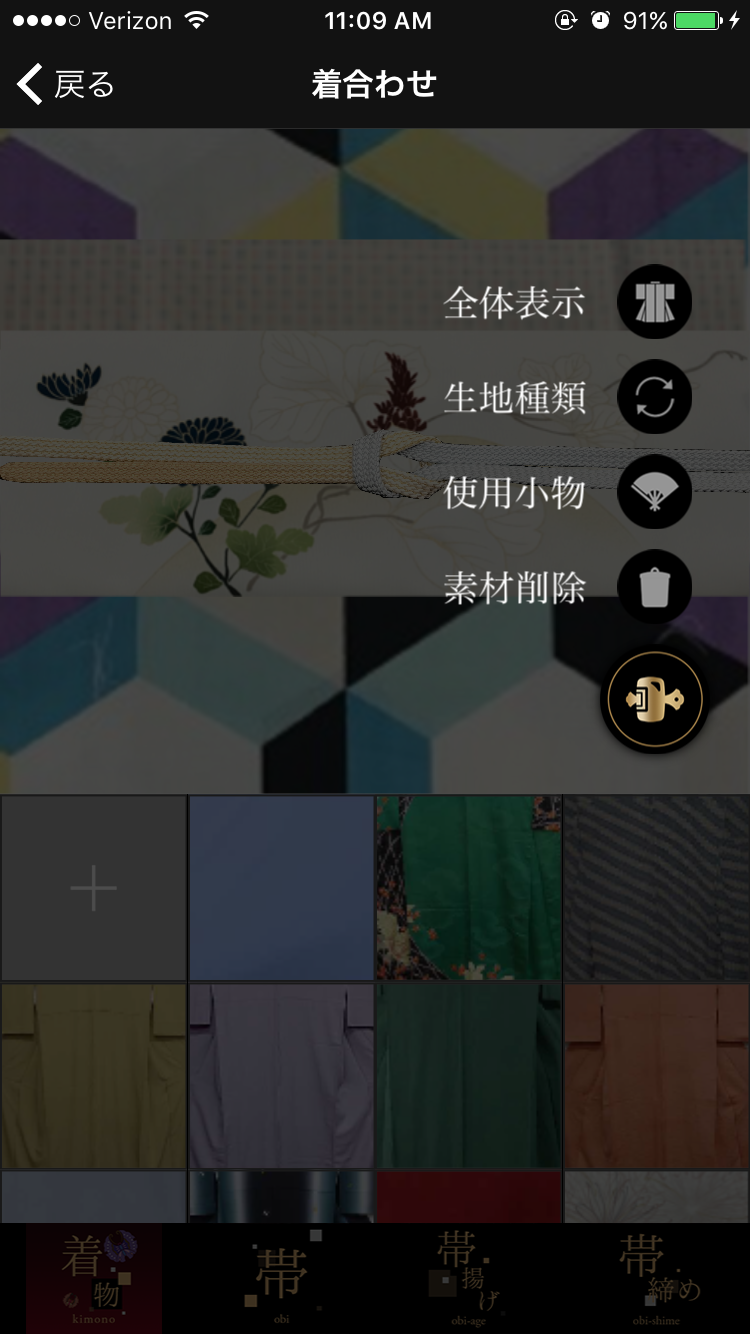
Options on coordination page:
1. See completed look
2. Change season (can choose awase/hitoe and usumono)
3. Purchase items in app
4. Delete images (only ones you've added)
Dressing Sample page
Convenient Book page 
Completed look

This app (and its complimentary yukata coordination app) is the only kimono coordination app I've been able to find so far for the iPhone. The app takes some time to load, especially the first time. It crashed on me several times until I just let it run for a little while and let it load all of the images. There are three main pages you can access from the title screen - the coordination page, the dressing sample page, and the "convenient book" page. The coordination page is the main feature and allows you to upload your own images (or use their provided ones, often items for sale) to compare kimono, obi, obiage, and obijime. Just select a swatch for each section, and it will add it to the image. Options can be selected by clicking the little hammer in the bottom right corner of the image. Selecting the kimono image will let you see the completed look. The next option allows you to change the season (can choose awase/hitoe and usumono). The third option (the fan) links you to items in app that can be purchased. The trash can allows you to delete images that you have added. I found that you need to be careful with the delete function because it can be easy to accidentally delete the wrong item, and you need to reselect delete to go back to coordinating. You also can't add any other accessories, so haneri, obidome, etc. are out.

Pressing a plus sign on page will allow you to upload an image of that item from your phone's pictures (for example, clicking on the obi page and then the plus sign will allow you to upload a picture of an obi in your collection). Each section will crop the image differently to fit that type of item. You'll probably need to play around with it to figure out which size/resolution images will work. I found that higher res images are really needed to get the best final results. As far as how different kimono types display, I was able to adequately show the kimono for several different formalities (houmongi, iromuji, komon, etc.). You can't change the sleeve length on the final image, so furisode will show up like houmongi, but for coordination purposes, it should be sufficient.

As for the other pages, the dressing sample page shows you pictures (real life and from the app) to give you inspiration. You can add your own coordinations by selecting the plus sign. The "convenient book" page has information about TPO, seasonality, etc., but it is very short and all in Japanese, so I found this to be less helpful.

In conclusion, this app will definitely work if you want a quick check on an ensemble you're planning, but don't expect any high quality images or advanced functions.


Here's the TL;DR pros and cons of this app:

Pros
  • Able to see items in kimono silhouette
  • Can save completed looks to phone
  • Free
  • Mostly self-explanatory and some English so little to no Japanese language is required for coordination functions
Cons
  • Slow to load
  • Japanese only on "convenient book" pages
  • High res pictures needed for the best final images
  • Shading on completed looks can distort colors
  • Obijime looks awful unless using their provided images
  • Can't delete sample coordination items (can actually buy some of these from the app)
  • Can be too easy to accidentally delete your items
  • Can't coordinate haneri, obidome, or other accessories

Tuesday, August 22, 2017

Getting caught up...

I forgot to post a few things here that happened in the last month or so. First, after I finished this handmade kimono, I tried to make a few more; this time from tanmono. The first is a poly ro komon, and the second is a cotton yukata. I wanted to style the yukata before posting pictures of it in its finished form, so this is just a shot of the okumi seam so you can see the progress. (I hope you'll forgive any sewing issues, especially on the poly komon, as the fabric was difficult to work with, and I'm definitely not a professional!)

I'm having a really difficult time trying to figure out what obi to use with the yukata. I guess it's just so neutral that almost anything would work, so I guess it just depends on what kind of look I'm going for, but I'm still lost...


On anther note, my son also got to experience his first tea ceremony class. And by "experience", I mean that he largely slept through it! ๐Ÿ’ค 
And you know I just had to have him wear something appropriate, so I got this little yukata-like onesie with crabs on it. ๐Ÿ˜†